
Straightening your teeth used to mean one thing: metal brackets, wires, and a couple of years of patience. That is no longer the only path. Clear braces and clear aligners have become a genuinely good option for a wide range of patients, and for many adults in Bay Ridge, they have become the preferred option.
At the same time, metal braces still do things that clear options cannot. They handle complex malocclusion more predictably, they cost less, and they require zero discipline from the patient because you cannot take them out. Choosing between the two is not about which one is newer or more popular. It is about which one actually matches your teeth, your case, and how you live.
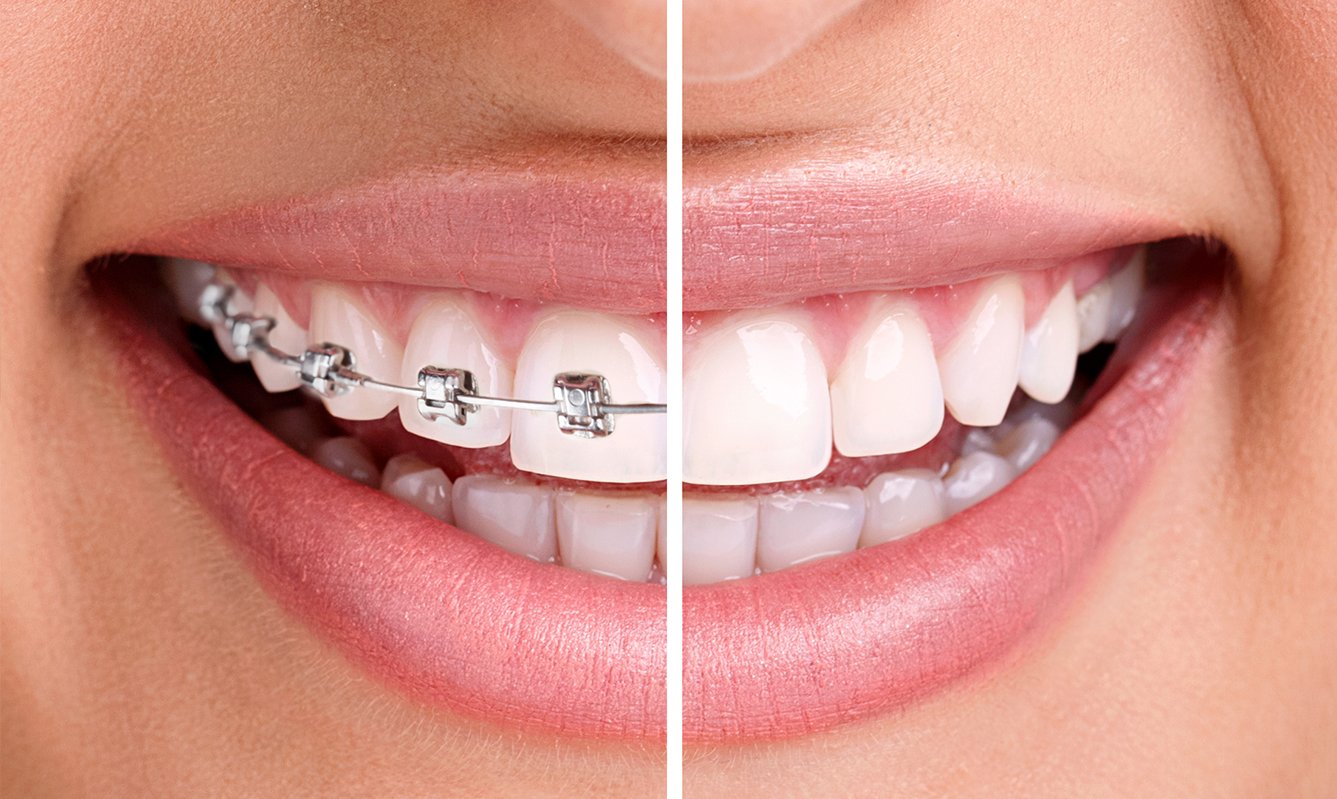
Clear braces are a term that covers two different things, and it is worth knowing the distinction before you commit to either.
The first is ceramic braces. These work exactly like metal braces, with brackets bonded to each tooth and a wire running between them, but the brackets are made from tooth-colored ceramic material. They are fixed in place for the duration of treatment and are far less visible than metal, though not completely invisible up close.
The second is clear aligners. These are removable trays made from transparent plastic that fit snugly over your teeth and apply gentle pressure to shift them gradually into position. At New Wave Dentistry, we offer both Invisalign and SureSmile, two of the most widely used aligner systems available. Each works from a series of custom-made trays, with patients moving to a new tray every one to two weeks as treatment progresses. Because they are removable, you take them out to eat, drink, and brush, which makes oral hygiene significantly easier than with fixed braces.
Clear aligners are particularly popular with adult clear braces patients who want orthodontic treatment without it being obvious at work or in social settings. They are also a comfortable option for people who play contact sports or instruments.
Traditional metal braces have been the backbone of orthodontics for decades, and there is a straightforward reason they are still in widespread use: they work reliably on virtually every case, including complex ones.
Metal braces use stainless steel brackets bonded directly to each tooth, connected by an archwire that is adjusted periodically by your dentist. That consistent, precise force is what makes them the more dependable choice when dealing with significant malocclusion, severe crowding, or complex overbite correction. The American Association of Orthodontists notes that fixed appliances give clinicians more control over tooth movement than removable ones, which matters when the movements required are large or precise.
Because they are bonded in place, there is no compliance issue. You cannot forget to wear them, and you cannot take them out before a meeting and leave them on your desk. For younger patients, especially, that reliability often produces better outcomes than removable options. They are also the more affordable route, which for many families is the deciding factor.
Most articles push you toward one option. The honest picture is more nuanced than that. Here is how the two compare across the factors that actually matter to patients.
| Factor | Clear Braces or Aligners | Traditional Metal Braces |
| Visibility | Nearly invisible, barely noticeable | Clearly visible, silver metal |
| Cost (Brooklyn estimate) | $3,500 to $7,000 | $2,500 to $5,000 |
| Treatment time | 12 to 18 months for mild to moderate cases | 18 to 36 months, depending on complexity |
| Comfort | Smooth plastic, no sharp edges | Can irritate cheeks and gums initially |
| Maintenance | Remove to eat and brush, clean trays daily | More complex brushing, food restrictions |
| Best for | Mild to moderate crowding, adults, discretion | Complex cases, all ages, tighter budgets |
| Patient discipline needed | High, must wear 20 to 22 hours daily | Low, fixed in place |
| Complex bite correction | Limited in severe cases | Handles most complex cases well |
Cost figures are estimates based on typical Brooklyn-area ranges and will vary depending on case complexity, treatment length, and insurance coverage. Your exact cost will be confirmed at your consultation.
Clear braces cost in Brooklyn typically falls between $3,500 and $7,000 depending on the system used, the complexity of your case, and how long treatment takes. Invisalign and SureSmile are both priced in a similar range, with more complex cases sitting toward the higher end. Metal braces generally run between $2,500 and $5,000 for the same range of cases, making them the more budget-friendly option when cost is the primary concern.
The good news is that many dental insurance plans cover a portion of orthodontic treatment regardless of which system you choose. At New Wave Dentistry, we work with most major PPO plans and will walk you through exactly what your plan covers before any treatment begins. We also offer flexible payment options to spread the cost over time. To get a clear picture of what your specific case would cost, the most useful step is a consultation where Dr. Ghannoum can assess your teeth and give you a real number rather than a range. You can check what your dental insurance covers on our insurance page before your visit.
There is no single right answer here. The better question is which option suits your specific bite, your habits, and how important discretion is to you.
You have mild to moderate crowding, spacing, or alignment issues, and you want a solution that fits into adult professional life without being obvious. Invisible braces for adults work well when the orthodontic movements required are not extreme, and when you are committed to wearing the aligners for the recommended 20 to 22 hours per day. Patients who travel frequently, play wind instruments, or are simply uncomfortable with the look of metal hardware tend to find aligners the easier fit.
Your case involves significant malocclusion, a severe overbite, rotated teeth, or vertical movements that require a higher degree of control. Metal braces are also the more practical choice if you know from experience that you struggle with compliance with health-related routines. A clear aligner sitting in a pocket instead of in your mouth will not move your teeth. For patients on a tighter budget, metal braces remain the more affordable path to the same destination.
Severe bite problems, including significant overbite, underbite, or crossbite, are areas where traditional braces have a clear advantage. That said, clear aligner technology has improved considerably, and some moderate bite issues can now be addressed with aligners that would previously have required fixed appliances. Dr. Ghannoum will assess your bite specifically rather than making a blanket recommendation.
This is the most common reason adults in Bay Ridge choose transparent braces. Clear orthodontic braces and aligners are genuinely difficult to notice in conversation, and most patients report that colleagues and friends do not even realize they are undergoing treatment. If discretion is your main priority and your case is not highly complex, clear aligners are usually the stronger recommendation.
Some cases sit right at the boundary between what aligners can and cannot handle reliably. Teeth that need significant rotation, large vertical movements, or correction of multiple issues simultaneously fall into this category. In those situations, an in-person assessment with digital X-rays and a full bite analysis is the only way to give you an honest answer. A consultation at New Wave Dentistry takes around 30 minutes and will tell you definitively which route makes sense for your teeth.
Choosing where to get orthodontic treatment is as important as choosing which treatment to get. A clear aligner system is only as good as the clinical judgment behind it.

If you have been thinking about straightening your teeth and are not sure which route makes sense, the most useful thing you can do is get a professional assessment rather than trying to work it out online. Clear braces and metal braces both produce excellent results when matched to the right patient.
Dr. Sammy Ghannoum has been helping Bay Ridge patients make exactly this decision for nearly three decades, and the consultation will give you a straight answer based on your actual teeth rather than a general recommendation. Book an orthodontic consult at our Bay Ridge office and find out which option is right for you. Most PPO plans are accepted, and same-week appointments are available.